In the United States, the overall cost of the full-mouth dental implants is usually between 30000 to 60000 and above in case of any restoration of both upper and lower arches using fixed teeth that are supported by an implant. Higher-level care with the premium braces made of zirconia, lots of bone grafts, dimensional sedation or other implants will cost more than 70 000.
One All-on-4 only restoration can be as expensive as approximately $11,640 to 27,500 with a reported national average of about 15,176. This number could, however, refer to a single dental arch and not to the whole mouth. Patients replacing teeth on both jaws must thus request a written estimate of the upper arch, lower arch and all the procedures involved.
The overall cost will be determined by the health of your jawbone, the amount of implants, the prostituing material, the experience of dentist, the location of clinic and the need to perform other procedures like extractions or bone grafts.
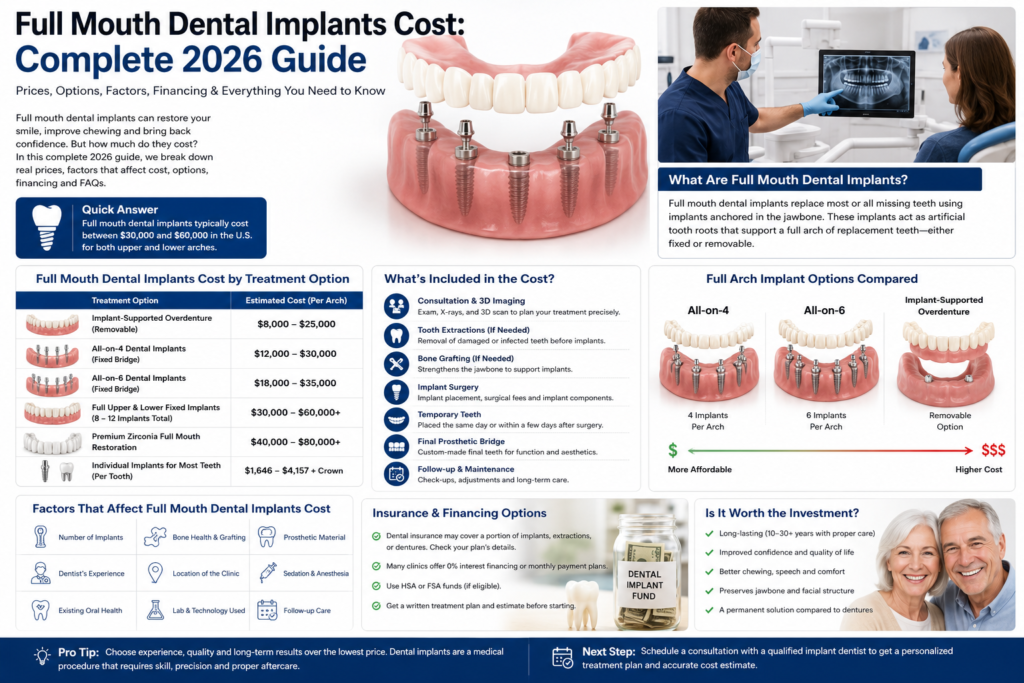
How Much Do Full Mouth Dental Implants Cost?
A realistic planning range for full mouth dental implants is:
| Treatment option | Estimated cost |
|---|---|
| Removable implant-supported overdenture | $8,000–$25,000 per arch |
| All-on-4 fixed bridge | $12,000–$30,000 per arch |
| All-on-6 fixed bridge | $18,000–$35,000 per arch |
| Full upper and lower fixed implants | $30,000–$60,000+ |
| Premium zirconia full-mouth restoration | $40,000–$80,000+ |
| Individual implants for most teeth | $60,000–$100,000+ |
These figures are general market estimates rather than guaranteed prices. A dental examination, panoramic X-ray and three-dimensional scan are normally necessary before an accurate quote can be prepared.
Featured-Snippet Answer
How much does a full mouth of dental implants cost?
Full mouth dental implants typically cost between $30,000 and $60,000 in the United States, although treatment may be lower or considerably higher. All-on-4 dental implants often cost $12,000 to $30,000 per arch, while premium zirconia restorations, grafting and sedation can increase the total.
What Are Full Mouth Dental Implants?
Full mouth dental implants are teeth replacement systems that use implants that are inserted into the jawbone to replace most or all of the missing teeth. The implants are artificial teeth roots, which promote a removable denture or fixed bridge. Instead of merely supporting a denture on the gums as many traditional dentures do, implants receive support of the jaw.
Through the process of osseointegration, the bone over time fuses with the implant surface. This provides a solid platform to a crown, bridge or complete arch of artificial teeth. Full mouth implants are not necessarily called so because an implant is put in place in every tooth that is missing. The average patient is implanted between four and six in each jaw. These implants are in favor of one entire arch of a bridge with a series of replacement teeth.
Full Mouth Implant Options and Their Costs
All-on-4 Dental Implants
All-on-4 treatment uses four strategically positioned implants to support a complete arch of fixed teeth. The rear implants may be placed at an angle to make better use of the available bone.
The All-on-4 dental implants cost commonly falls between $12,000 and $30,000 per arch. Restoring both arches could therefore cost approximately $24,000 to $60,000.
Lower advertised prices may cover only the surgical placement and temporary teeth. Patients should confirm whether the quotation includes:
- Tooth extractions
- Implant placement
- Temporary fixed teeth
- Final permanent bridge
- Sedation or anaesthesia
- Follow-up appointments
- Repairs and maintenance
“Teeth in a day” normally means that implants and temporary teeth are placed during one appointment. The permanent bridge is generally fitted after the implants and surrounding tissues have healed.
All-on-6 Dental Implants
With the All-on-6, there are 6 implants instead of four. The extra implants can enhance force balance and offer them more support when the patient has the appropriate bone. The cost of an All-on-6 restoration can be between 18,000 and 35,000 per arch. This price can be more than All-on-4 as many more implants, components and surgical work are included.
Treatment that has the largest number of implants is not necessarily the best treatment. The number of the implant ought to depend on the bones structure, the bite pressure, medical history, and constructions of the prosthetic.
Implant-Supported Overdentures
A snap-in denture, also known as an implant-supported overdenture, is an overdenture that is connected to implants, which may be taken out to clean. Generally more stable compared to a conventional removable denture, but typically less expensive than a permanently fixed bridge.
Prices Could vary between 8 to 25 thousand dollars per arch according to the number of implants, attachment system and denture material.
Patients who want to have a greater level of stability and at the same time have a lower overall cost of their treatment might be interested in this option. Nonetheless, denture and attachment sub-units might also need a certain number of replacements periodically.
Individual Dental Implants
A complete tooth loss can hardly require replacing all of them with separate types of implants. An implant post alone might only cost between $1,646 and 4,157 and the crown may only cost between 488 to 3,254. The total of repeating this process in a whole mouth, can be exceptionally costly. Individual implants can also be used when a few teeth are missing, or separate teeth supported by implants can be used to retain healthy natural teeth.
What Is Included in the Price?
A full mouth dental implant quotation may combine several separate services. Understanding these charges makes it easier to compare providers accurately.
Consultation and Three-Dimensional Imaging
The first stage usually includes an oral examination, medical history review, photographs, X-rays and a cone-beam computed tomography scan. Three-dimensional imaging helps the dentist evaluate bone height, bone width, nerve position and sinus anatomy.
Tooth Extractions
Damaged or infected teeth may need to be removed before implants are placed. Simple extractions generally cost less than surgical removal of broken or impacted teeth.
Some patients have extractions and implant placement during the same appointment. Others need a healing period between the procedures.
Bone Grafting
Bone grafting may be recommended when the jaw does not have enough volume to support implants. The graft can increase both treatment cost and total healing time.
Not every patient needs extensive grafting. All-on-4 techniques may sometimes use angled implants to avoid areas with limited bone, but suitability must be determined through clinical assessment.
Implant Surgery
Surgical charges include implant placement, implant components, sterile materials and the clinician’s professional fee. The price may increase when guided surgery, specialist care or complex anatomical planning is required.
Temporary Teeth
Many full-arch patients receive temporary fixed teeth while the implants heal. These teeth are designed for appearance and light function but may not have the durability of the final prosthesis.
Final Prosthetic Bridge
The final bridge is one of the largest components of the total cost. Acrylic teeth supported by a metal framework are generally less expensive than monolithic zirconia.
Zirconia can provide excellent durability and appearance, but no bridge material is indestructible. Design, bite balance, cleaning access and laboratory quality are as important as the material itself.
Factors That Affect Full Mouth Dental Implants Cost
Number of Implants
Using six implants instead of four generally increases surgical and component costs. Additional implants may be recommended for stronger support, but they should have a clear clinical purpose.
Upper Arch Versus Lower Arch
The upper jaw often has softer bone and may be affected by the position of the sinuses. Some upper-arch cases require sinus augmentation or specialised implants, which can raise the price.
Prosthetic Material
Acrylic, composite and zirconia restorations have different manufacturing costs, maintenance requirements and expected service lives. Premium materials and customised laboratory work normally increase the final fee.
Dentist’s Training and Experience
An experienced implant dentist, prosthodontist, periodontist or oral surgeon may charge more than a general provider offering a promotional package. Complex full-mouth treatment requires careful coordination between surgery, prosthetic design and long-term maintenance.
Geographic Location
Prices are often higher in major metropolitan areas because of differences in wages, laboratory charges and operating costs. Travelling to another region may reduce the initial price, but patients must also consider travel, accommodation and follow-up visits.
Sedation
Local anaesthesia may be included, while oral sedation, intravenous sedation or general anaesthesia may involve additional fees.
Existing Oral Health
Active gum disease, infection, uncontrolled diabetes, smoking and severe bone loss may affect healing and treatment planning. These conditions may need to be managed before implant surgery.
Are Full Mouth Dental Implants Covered by Insurance?
Dental insurance coverage varies considerably. Some plans exclude implants, while others cover a percentage of the implant, extraction, denture or crown cost. Even when implants are included, the policy may have an annual benefit limit that covers only a small portion of full-mouth treatment.
Before beginning treatment, request:
- A detailed treatment plan with procedure codes
- Written insurance pre-authorisation
- The estimated insurance contribution
- The patient’s expected out-of-pocket cost
- Information about annual maximums and waiting periods
Medical insurance may occasionally contribute when tooth loss is connected to trauma, cancer treatment or a qualifying medical condition, but approval is not guaranteed.
How to Make Full Mouth Implants More Affordable
Compare Complete Written Quotations
Obtain two or three detailed treatment plans. Compare the number and brand of implants, temporary teeth, final bridge material, grafting, sedation and follow-up care.
The lowest headline price may not include the permanent teeth.
Ask About Phased Treatment
Some patients can complete treatment in stages. This may spread costs over a longer period, although it is not suitable for every clinical situation.
Use Dental Financing
Many clinics offer monthly payment plans through third-party healthcare lenders. Review the interest rate, deferred-interest conditions, total repayment amount and late-payment penalties before signing an agreement.
Consider Dental Schools
University dental programmes may provide treatment at reduced rates under specialist supervision. Waiting times can be longer, and not every school accepts complex implant cases.
Use Tax-Advantaged Accounts
Eligible patients in the United States may be able to use Health Savings Account or Flexible Spending Account funds for qualifying dental treatment.
Are Cheap Dental Implants Worth It?
A reduced price does not automatically mean poor treatment. However, patients should be cautious when a clinic advertises a price far below the normal market range without clearly explaining what is included.
Ask the provider:
- Who will perform the surgery?
- What implant system will be used?
- Is the quoted price for one arch or both?
- Are temporary and permanent teeth included?
- What material will be used for the final bridge?
- Who provides emergency and long-term care?
- What happens if an implant fails?
- Are repairs included in the warranty?
Dental implants are surgical treatments and can involve infection, nerve injury, delayed bone healing, damage to neighbouring teeth and implant failure. A thorough examination and appropriate professional care are therefore more important than choosing a provider solely by price.
How Long Does Full Mouth Implant Treatment Take?
Treatment may take approximately three to twelve months. The exact timeline depends on extractions, bone grafting, implant stability and healing.
The usual stages include:
- Consultation and three-dimensional imaging
- Extractions or grafting, when required
- Implant placement
- Temporary teeth
- Osseointegration and healing
- Final impressions or digital scans
- Permanent bridge placement
- Maintenance appointments
Patients may leave surgery with temporary teeth, but this does not mean biological healing is complete. Softer foods and careful cleaning may be required during the healing period.
Frequently Asked Questions
How much are full mouth dental implants for both arches?
Both arches commonly cost around $30,000 to $60,000 or more. Premium materials, grafting and complex surgery can increase the total beyond $70,000.
Is the advertised All-on-4 price for one arch?
Many advertised All-on-4 prices apply to one arch only. Ask whether the quote includes the upper jaw, lower jaw or both.
What is the cheapest full mouth implant option?
A removable implant-supported overdenture is generally less expensive than a fixed zirconia bridge. Conventional dentures are cheaper still but are not supported by implants.
How many implants are needed for a full mouth?
Many patients receive four to six implants per arch, resulting in eight to twelve implants for both jaws. The correct number depends on bone anatomy and prosthetic planning.
Are full mouth implants permanent?
The implants are intended to remain in the jaw long term. However, the bridge, screws or attachment components may eventually require repair or replacement.
Can full mouth implants be completed in one day?
Implants and temporary teeth may sometimes be placed on the same day. Permanent teeth are normally fitted after healing and osseointegration.
Does Medicare cover full mouth dental implants?
Original Medicare generally provides limited routine dental coverage. Coverage may differ under Medicare Advantage plans or when dental treatment is directly connected with a covered medical service.
Can I finance full mouth dental implants?
Yes. Many clinics provide third-party financing or structured payment options. Compare interest rates and total repayment costs rather than focusing only on the monthly payment.
Are zirconia teeth worth the additional cost?
Zirconia may provide excellent strength, stain resistance and appearance. Its value depends on bridge design, laboratory quality, available space, bite forces and the patient’s maintenance habits.
How long do full mouth dental implants last?
Implants can function for many years or decades when they integrate successfully and receive appropriate care. Longevity depends on oral hygiene, smoking status, general health, bite forces and regular professional maintenance.
Final Thoughts
Dental implantation in the full mouth is generally priced between $30,000 and 60,000 (two arches), and has no specific pricing. The different costs, advantages and maintenance needs of all-on-4, All-on-6, snap-in dentures, and premium zirconia bridges differ. The quotation most handy is not necessarily the lowest priced one. It must explicitly detail the quantity of implants, surgery operations, short term restoration, final bridge material, post operative treatment and possibly extra fees. With a financial decision, a thorough evaluation should be organized by a well-qualified implant expert. The only sure way to know your actual full set dental implants price would be a personalised clinical plan.